Building on Existing Theories of How Teachers Learn: Preparation, Commitment, Relationship, and Agency
Citation (APA 7th): Allen, A. (2025). Building on existing theories of how teachers learn: Preparation, commitment, relationship, and agency. The Teacher Educators’ Journal, 18, 1–31. https://doi.org/10.66196/VIKP9553
Amy Allen
Virginia Polytechnic Institute and State University
Abstract
Despite the promise of discussion-based pedagogy in fostering democratic habits and critical thinking, classroom discussion remains underutilized in elementary social studies. This qualitative case study investigates how three elementary teachers learned and implemented discussion strategies introduced through a series of professional development (PD) sessions. Framed by theories of personal and personal practical knowledge, the study explores the relationship between teacher learning and practice. Drawing on interviews, classroom observations, and analytic memos, four interrelated factors emerged as critical to teacher uptake: preparation, commitment, relationship, and agency. Findings illustrate that teachers’ prior experiences, perceived control, and levels of support significantly influenced whether and how PD learning was integrated into instruction. Rather than assuming a linear relationship between exposure and implementation, this study emphasizes the complex and relational nature of teacher learning. It highlights the importance of sustained, content-specific PD grounded in trust, reflection, and contextually responsive mentorship. Ultimately, this research contributes to our understanding of how in-service teachers translate PD into practice and underscores the unique opportunities and challenges of fostering authentic discussion in elementary social studies classrooms.
Researchers find distinct learning differences between classrooms where students passively receive information versus classrooms where students have an active, participatory role (Barton, 1995), and learning how to engage in critical dialogue about diverse beliefs is vital for a functioning democracy (Mitra et al., 2017). However, though multiple studies indicate the necessity of including discussion or dialogue in elementary classrooms (Hess, 2004; Klinzing & Rupp, 2008), research shows teachers are more likely to engage students in recitation disguised as discussion than generative dialogue (Applebee et al., 2003; Larson, 1996; Parker & Hess, 2001).
Just like elementary school provides the foundation for literacy and math skills, it should also lay the foundation for the skills students need to be successful in social studies and as future citizens throughout their life, including the ability to synthesize diverse thoughts and express their opinions (Libresco, 2018; Mitra et al., 2017; Swalwell, 2015). While there are some questions about when to engage in meaningful discussions with young students, research shows children can deal successfully with ideas that are developmentally appropriate and highly scaffolded (Boutte, 2008; Hess, 2009; Nance-Carroll, 2021). However, if students have not been introduced to effective discussion strategies from a young age, it is unrealistic and unfair to expect them to know how to engage during middle and high school.
However, merely suggesting elementary school teachers engage in discussion-based strategies is not enough. Conducting an effective discussion is a difficult feat even for the most seasoned educator and teaching preservice teachers how to lead them is even more challenging (Demoiny, 2017; Hawkman et al., 2015; Parker & Hess, 2001). Many teachers who feel unprepared for or fearful of engaging in classroom discussions ignore student questions and social justice issues or gloss over them superficially (Bickmore et al., 2015; Engebretson, 2018; Houser, 1996). The absence of discussions that lead to critical dialogue is problematic because students “who are denied the experience of grappling with these complex social controversies grow up developing intercultural misunderstandings that often lead to discrimination and bias” (Bersh, 2013, p. 47). Research shows critical classroom conversations to be the exception, not the norm (Bickford, 2021; Mitra et al., 2017; Serriere, 2010; Serriere et al., 2017).
Knowing more about how teachers learn is crucial to equipping teacher educators in developing professional development (PD) experiences that will positively impact the classroom practice of inservice teachers (Desimone, 2009). These opportunities should build on what is known about the ways teachers construct knowledge (Clandinin & Connelly, 1987) and bridge the gap between theory and practice (Korthagen, 2017) to provide new information teachers are able to embody and implement in school. Given this, there is a need to evaluate how teacher educators provide instruction in theory and pedagogical practice and, more specifically, in an area where current literature shows a deficit: facilitating classroom discussions in elementary social studies. The primary purpose of this study was to consider why some teachers are able to learn (as evidenced by implementation/integration into their practice) specific techniques and theories. To investigate this question, I investigate how teachers learn and implement discussion-based teaching strategies in elementary social studies as introduced through a series of PD sessions.
Discussion in Elementary Classrooms
Classroom discussion, a form of group inquiry that allows for a purposeful exchange, has the power to expand the mind and build community (Parker & Hess, 2001). It is not simply recitation — “the IRE [initiate-respond-evaluate] pattern of teacher–student interaction wherein the teacher initiates talk with a question, a student responds, and the teacher evaluates the response for adequacy” (Parker & Hess, 2001). In an authentic discussion, students are not trying to find the answer the teacher is looking for; instead, they are exploring ideas and conducting inquiry with a group of fellow learners also engaged in a journey for the truth. These lived experiences influence teachers and their ability to conduct or participate in classroom discussions or critical dialogue. Its presence in a classroom helps students develop critical thinking skills; its absence indicates an environment where knowledge lives solely within the teacher (Hess, 2004). Distinct learning differences exist between classrooms where students passively acquire information versus classrooms where students actively participate (Barton, 1995), and discussion-based pedagogy is crucial to a classroom environment where students are required to think rather than simply regurgitate information (Hess, 2004).
Unfortunately, within U.S. schools discussion-based strategies are seldom effectively implemented (Hess, 2004; Klinzing & Rupp, 2008). Research shows children can comprehend ideas that are developmentally appropriate and scaffolded (Bickford, 2021; Hess, 2009; Serriere et al., 2017). Yet if students have not been introduced to effective discussion from a young age, it is unrealistic to expect them to know how to engage during middle and high school or as future citizens (Mitra et al., 2017). Though teachers frequently question whether young students are able to engage in discussion, especially critical dialogue, studies have shown even the youngest of our students are able to take the perspective of others, consider ethical dilemmas and participate in thoughtful conversations about hard questions (Mitra et al., 2017; Serriere, 2010; Serriere et al., 2017). Beyond this, some researchers argue that participating in critical dialogue as citizens is only possible if you have had the opportunity to practice this skill from a young age (Hess, 2009; Mitra et al., 2017).
Not only are students able to engage in critical dialogue; it is crucial they do. Children are not protected from the inequity that exists in the world (Nance-Carroll, 2021). Many children are already experiencing the repercussions that result from a lack of justice without the benefit of grappling with why inequity exists. Refusal to talk about certain topics, like racism, sexism, or politics, can be comforting to adults, but leaves children vulnerable to misinterpretation (Nance-Carroll, 2021). While we, as teachers and educators, wait for young students to be ready to talk about fairness, equity, or justice, our students are already developing their own worldview about these issues (Boutte, 2008; Serriere, 2010; Serriere et al., 2017).
Unlike subjects that privilege fixed answers or procedural mastery, social studies invites engagement with complexity, controversy, and multiple perspectives (Hess, 2004; Mitra et al., 2017). These are not incidental features but core democratic aims of the field. As Parker and Hess (2001) argue, authentic discussion expands the mind and builds community, yet within social studies classrooms, such dialogue remains the exception rather than the norm (Bickford, 2021; Serriere, 2010; Serriere et al., 2017). The paradox between the ideals of the discipline and the realities of classroom practice makes social studies a critical site for inquiry into how teachers learn and implement discussion-based strategies.
Teacher Professional Development
Complicating this topic is the difficulty teachers face in implementing discussion based teaching strategies. Even if introduced to effective discussion based strategies, teachers fall back on their own educational experiences as the primary model for their instruction (Lortie; 1975; Parker & Hess, 2001). This is hardly surprising, since little research models or provides explicit examples of strategies used by social studies teachers to discuss complex topics (Demoiny, 2017), nor do preservice teachers witness effective social studies instruction during their field experiences (Hawkman et al., 2015). Even when examples of students engaging in discussion are provided (Bolgatz, 2007; Rice, 2005) or the use of discussion based pedagogy is implied in practitioner resources, how to facilitate discussion is rarely the primary topic under consideration.
Simply suggesting elementary school teachers engage in authentic discussion or critical dialogue or asking them to encourage student voice is not enough. Research shows facilitating effective discussions is difficult, even for experienced educators, and teaching teachers how to lead them can be just as challenging (Bickmore & Parker, 2015; Parker & Hess, 2001). Many teachers are reluctant to discuss controversial topics because of a perceived threat to their social, professional or personal security (Engebretson, 2018; Houser, 1996). In the present political climate, engaging in discussion of controverial issues has indeed proven to be dangerous, leading to job loss or worse for even well-established teachers (AHA, 2024; Branson-Potts, 2016; Dunn et al., 2019; Natanson & Balingit, 2022). Discussions about controverial issues may also be avoided because teachers fear they may lose control of the discourse (City, 2014; Hess, 2004; Klinzing & Rupp, 2008). As Serriere et al. (2017) point out, this is a legitimate concern: “Dialogues — unlike fully, pre-determined lessons — cannot be controlled to arrive at a chosen conclusion, no matter how desirable that might be” (p. 11). As a result, many teachers choose to address social issues only in response to direct and persistent questioning and quickly drop them and return to safer topics (Houser, 1996).
Fostering dialogue takes practice and intention, and methods professors, field supervisors, and school administrators should all support teachers attempting to engage in these activities (Demoiny, 2017; Hawkman et al., 2015; Mitra et al., 2017). Research showing a lack of ability for facilitating discussion by inservice teachers points to a need for effective PD that helps teachers construct knowledge and skill in this area, and scholars suggest a need to identify and address elements that impact the quality of PD, especially features that impede or facilitate teacher learning (Heineke, 2013). Even when classroom teachers want to engage in authentic discussion or critical dialogue with students, many feel unprepared to do so (Demoiny, 2017; Engebretson, 2018); teachers “need stronger support in creating opportunities for students to substantively discuss ideas” (Callahan et al., 2016, p. 239).
Within elementary social studies, the professional development landscape is marked by scarcity and inconsistency, further justifying this study’s social studies context (Brugar & Roberts, 2017; Callahan et al., 2016; Halvorsen and Kesler-Lund, 2013). Sessions that address social studies content areas are rarely provided (Brugar & Roberts, 2017; Callahan et al., 2016) or disconnected from teachers’ lived realities (Halvorsen & Kesler-Lund, 2013). Even well-intentioned programs struggle with what Callahan et al. (2016) describe as “the workshop problem”: limited time, incoherence, and passive delivery. By situating this study in the context of elementary social studies PD, the research responds to both a disciplinary imperative and a practical need: to better understand how teachers learn to foster discussion in classrooms where the stakes are civic and the supports are few.
Existing Conceptions of Knowledge in Teacher Education
There is a sizable gap between theory and practice within teacher education (Korthagen, 2017; Korthagen et al., 2006). Even if prospective teachers have been taught pedagogical methods backed by theory, they may not be able to implement them in the classroom. This divide is also present in conceptions of knowledge. If knowledge is just information, then education could exist as the passive transfer of content, and, in many classrooms, it does (Meek, 2011). The perspective of knowledge as information creates passivity, indifference, inaction, and compartmentalism in learners. Pedagogical practices such as replacing lectures with discussions, service learning, and experiential learning have been introduced to address this defective epistemic model (Meek, 2011), but this is not enough. Reform is needed within the field of teacher education in a way that challenges this false dichotomy through knowledge as transformation (Meek, 2011).
If teachers do not learn simply from being presented with educational theories, how do they learn? This framework for this study primarily focuses on the intersection of personal knowledge (Meek, 2011; Polanyi, 1958; Poirier, 2011) and personal practical knowledge (Clandinin & Connelly, 1987; 2000; Feiman-Nemser, 2012). In his theory of personal knowledge, Polanyi suggests knowing is profoundly situated within the human person; there is no impersonal knowledge (Poirier, 2011). Who one is impacts the decisions they make and, with the passage of time, a person’s decisive abilities continue to grow and change (Poirier, 2011). Because individuals are constantly changing, they are apt to make slightly or significantly different decisions over time. Contextually aligning with the theory of personal practical knowledge (Clandinin & Connelly, 1987), the theory of personal knowledge (Polanyi, 1958) suggests the community in which an individual develops and matures has a profound effect on what he/she later affirms in life (Poirier, 2011), and in any field where the goal is “knowing,” those seeking knowledge should deliberately endeavor to be influenced by the discipline's finest practitioners.
Methodology
In addition to being based on the principles of basic qualitative research (Miles et al., 2014), the present study leans on ideas of intimate scholarship (Strom et al., 2018) to examine the experiences of teachers participating in inservice PD sessions that modeled research-based practices for engaging in authentic discussion or critical dialogue through the use of discussion based teaching strategies with young children (Author, under review). The research question that guides this study is “Why are some teachers able to learn (as evidenced by implementation/integration into their practice) specific techniques and theories?”
Participants
This study took place at a mid-size private Christian school district in a large city in the South for grades PK-12. Although not all faculty members elected to participate in the study, all upper elementary faculty members across the district were required to attend the inservice sessions. As a result, a significant size group (around 16 teachers) was available for facilitating discussion as part of the professional development experiences. All full-time elementary teachers were invited to participate in the study via a school-wide email, and, using criterion sampling (Creswell, 2012), three of these 16 faculty participated in the study: Trista, Faye, and Sabrina. Background information about each participant is included in Table 1. Participating in the study was different from simply participating in the PD offered by the school, as study participants were also required to complete interviews about their experiences and teach lessons using the new strategies, which I observed.
Table 1.
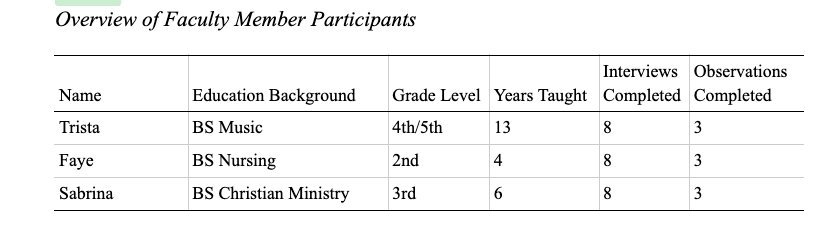
Because of the nature of intimate scholarship, which directly engages a researcher’s personal experiences, knowledge, and practices (Strom et al., 2018), in addition to the faculty members who participated, I consider myself a participant. At the time of the study, I was the Director of Educational Development for the district and acted as a de facto instructional coach. Outside of this role, it is unlikely I would have the ability to engage in sustained PD with faculty members.
Data Collection and Analysis
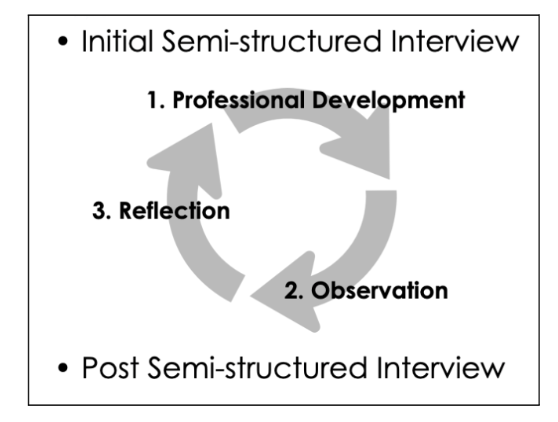
Data was collected through interviews, classroom observations, and analytic memos. Each participant completed eight recorded interviews: an initial interview, a follow-up interview after each of three PD sessions, a reflection interview after each observation, and a post-interview (Figure 1). Interviews were audio-recorded and transcribed verbatim. After each PD session, I visited classrooms to watch teachers implement the new discussion strategy. During each of these observations, I took field notes and coded them during the data analysis process. As a third data source, I created analytic memos to record initial impressions of interviews, PD sessions, and observations.
Figure 1
Overview of Study Sequence
Throughout the data analysis process, I relied on grounded theory analysis, using cumulative coding cycles along with reflective analytic memoing to develop categories for theory generation (Miles et al., 2014). After the second iteration of the professional development/observation/reflection cycle, I created a matrix (Miles et al., 2014) that included a list of study participants and professional development sessions to use as a guide when beginning to analyze the data collected. Looking at each participant individually, I read through data collected during the first and second professional development cycles chronologically to conduct an initial coding cycle. During each cycle, I looked for initial descriptive themes that stood out among the data and physically coded the data (Glaser & Strauss, 1967) and allowing concepts and hypotheses to emerge on their own.
After constructing initial themes, I completed data collection with the participants. Using codes developed from data analysis of the first two cycles, I looked through my field notes to look for continued examples of the themes that had previously emerged. I then fully transcribed all interviews for each teacher and worked through each teacher's transcribed data, intentionally looking for examples of these initial themes as well as new codes. Next, transitioning from vertical analysis to horizontal analysis, I engaged in the constant comparative method to look for common themes among participants and consider if and how each particular theme might be refined into a more abstractly defined category (Glaser & Strauss, 1967).
As part of the constant comparative method, I was constantly comparing new data with previously coded data to identify similarities, differences, and patterns. This iterative process helped refine codes and categories. As part of this process, four themes clearly emerged: preparation, commitment, relationship, and agency. Using these themes, I created a construct table (Miles et al., 2014) to organize defining examples of each category and integrate categories and themes concisely for analysis, leaving space to include examples later in the analysis process. Ultimately, each category could be seen as a factor providing insight about how teachers learn good technique and good theory as evidenced by implementation or integration into their practice.
Results
Because this study was rooted in notions of intimate scholarship, my relationships with the faculty participants as well as my values and beliefs about teaching and learning inform the meaning-making process. The examples I share here take into consideration more than explicit data that emerged from interviews and observations; they also recognize the long history I have with each participant, professionally and personally, which enhanced the ways I am able to present their stories accurately. Throughout this section, I tell the story of each participant individually to best present a holistic picture of each individual engaging on their own journey to learn new teaching strategies, as well as to fully represent the relational and intimate aspect of this study.
Trista
The first participant, Trista, taught a class of 16 fourth and fifth-grade students. She earned her BS degree in English/Music from a small liberal arts college and has 13 years of classroom experience across multiple grade levels. Trista was eager to participate because she enjoys improving her teaching craft and could be categorized as a model student. Categories that emerged around the way she learns included excitement and a desire to improve, integration of old and new practices, and support.
In our initial interview, Trista shared that discussion rarely occurred in her PK-12 experiences. Trista defined discussion as messy but one of the best ways to solidify information. In her everyday life, Trista feels discussion is “integral… Discussion is kind of the thing that kind of brings joy to a relationship, right? Without discussion, you're just taking care of business and coexisting.” Trista suggested the goal of engaging in discussion can be very different depending on who she is engaging with and why but sometimes Trista intentionally does not engage in discussion. These include when people have different opinions, a lack of time, or if participants are unprepared. She also mentions if the reason she chooses not to engage is time or not being prepared and she feels the discussion would be worthwhile, she will attempt to engage in that conversation later when the right factors are in place.
Unlike some of the participants, Trista was excited not only to participate but also to improve her own practice. At our first professional development session, she immediately turned to me and said “I know when I'm going to use this. I have a lesson about Irish home rule next week that I wasn't sure how I would teach, and this would be perfect.” Following her first attempt, she continued to use the strategy and was eager to tell me about those experiences. By the end of the study, she had conducted the combined discussion strategies at least seven additional times.
Throughout the year, Trista integrated new discussion techniques into existing classroom routines. One way she integrated old and new practices was in the way she deconstructed the discussion experiences. After both the philosophical chairs and fishbowl discussion activities, she gave students the opportunity to talk about how the lesson went. While this was a regular part of the PD sessions, in our follow up interviews, Trista shared it was also something she frequently did as part of her regular teaching practice. I was able to watch her conducting a debrief after both the philosophical chairs and fishbowl discussions. Following the debrief, Trista said she thought the experience would go better next time now that they understood the activity. The following week, they did attempt the fishbowl again and Trista confirmed that it went better. This example demonstrates the ways Trista used her regular classroom practices alongside new techniques in ways she later told me she was not always aware of doing.
In interviews reflecting on the PD sessions, Trista often mentioned specific experiences that provided an initial level of support for planning and enacting the discussion strategy. For example, after the second PD session, she said:
A lot of times, we'll do PD and not have an actual example of what we're looking at. So I liked that you had the example of the lesson and what you would have used in the stages you had gone through to teach that lesson… that's really helpful.
Similarly, after the third PD session, she said:
I mean, I don't want to say that there's never interaction and practice of the [strategy being taught], but it's not as common. And so I liked that, like getting to put it into practice. Especially with something that doesn't seem too contrived…
These experiences could be the reason she consistently shared that following our PD she felt more prepared to engage in discussion with her class by implementing the strategy presented.
Faye
The second participant, Faye, taught a second-grade class with ten students. She earned a BS degree in Nursing but is now in her fourth year of teaching in primary grades. From the start, Faye seemed unconvinced the topic of discussion would be useful in second-grade and could be categorized as a hesitant acceptor. However, by the end of the study, Faye seemed convinced discussion is a valuable tool, even in the early elementary grades. Categories that emerged around the way she learns included a hesitancy to fully buy in, imitation, and rarely seeking help.
In thinking about her PK-12 experience, Faye could only think of two teachers who engaged in discussions while teaching and attributed that to the fact that those teachers were “more relational with their students.” Faye was the most reluctant to fully buy in to not only participation in the study at large, but also participating in PD sessions and incorporating techniques into her classroom practice. Initially, she communicated, although she was unconvinced incorporating discussion in a second-grade classroom was a good idea or even possible, she was willing to give it a shot. After the first observation, she felt implementing the technique went fine but provided a caveat: “I think they did well for their age. Would have gone better with older kids.” In hindsight, she said, she would adapt the activity and provide more structure for younger students but was quite frank in admitting she was unlikely to try this strategy again, and during the study, she did not.
Despite her hesitancy, Faye continued with the study and over time, she appeared to buy in to the idea of discussion as a viable teaching strategy with second-grade students. Before the third observation, she said “I'm a little skeptical about how it will work in second grade if I'm honest. But we're going to try it.” During my observation, students were introduced to the fishbowl technique to discuss a classroom read-aloud. They politely and respectfully tapped in and out and engaged in critical dialogue at the second grade level (Author, under review).
After this final iteration of formally (and, in her mind, successfully) implementing a discussion based teaching strategy, Faye said:
It was pretty cool to see… Regardless of what method they're using to discuss, the more you do it, the better you get at it, even if you're using a different, you know, model to actually do it... I would much prefer to do more discussions… instead of just doing worksheets or whatever with the kids. The kids love it, you know, they prefer to do that too.
Over the course of the three sessions of PD surrounding discussion based teaching techniques, she moved from open hesitancy to positive acceptance and expressed a desire to not only continue to schedule the use of discussion strategies in her classroom but to schedule them so frequently that “down the line, I’ll be so used to integrating those that I’ll use them naturally.”
In the interview following the second PD session, Faye mentioned a key difference between this series of PD sessions and others she had participated in in the past was the inclusion and emphasis of real-life examples. Participation in the strategy gave Faye a tangible example of what implementing the strategy could look like, and she appeared to rely heavily on those examples when implementing the technique in her classroom. However, despite her hesitancy and reliance on imitation, unlike the other two participants, Faye rarely sought help in planning or preparing for the lessons she presented. In all three of the lessons I observed, Faye used pre-existing questions from worksheets she has already used in the past. For example, in the first session, she had students discuss life in Athens versus life in Sparta, “mainly because it was something easy for the kids to discuss.” In the second session, she paired the pyramid discussion with comprehension questions from a literature worksheet she regularly used because “I thought [this strategy] would go well with… what I already had.” Of note, of the three participants, her questions are the ones that were not able to move from fact-based, surface level questions to authentic, scaffolded questions.
In our final professional development reflection, Faye indicated she was skeptical about how using the fishbowl would work in second grade but did not ask for guidance on ways she might modify the technique for young students. I asked her to share how she planned to adapt the activity, and she explained her adaptations to me (having students stand in specific spots on the outside, larger groups talking, switching out the whole group at the same time). In response, I offered alternatives even though she did not request them. I reminded Faye that during the professional development session, I had participated as a member of the group, and if I was not inside the fishbowl, I was not talking. She then said:
I'd forgotten that you'd done that, and that was part of it. Because it would be very natural for me to just stand on the outside and talk. But you're right, if I do that, then it's really just me directing.
This example illustrates a potential desire and benefit for offering additional support even to teachers who are not actively requesting it.
Sabrina
The third participant, Sabrina, taught a third-grade class with eleven students. She earned her BS degree in Christian Ministry from a local, regional school while working full time. Most of her education training has been provided by her current school, where she has taught third grade for six years. Like Trista, Sabrina consistently seeks out PD opportunities that will help her grow as an educator and could be categorized as eager to please. Categories that emerged around the way she learns included a lack of experience, actively seeking help, and control.
Throughout her PK-12 education experience, Sabrina was unable to recall a specific experience with discussion until her junior and senior year of high school. In our initial interview, she defined discussion as “the free sharing of ideas without judgment” and said she enjoys engaging in discussion. Despite this, she indicated there are times she consciously chooses not to engage in discussion if she does not feel prepared to talk about a topic, if she disagrees with a perspective, or if she does not think it is appropriate. In the classroom, this may mean redirecting the student to talk to a parent.
Sabrina's ability to implement new strategies appears to be negatively impacted by her lack of formal education training as many fundamental teaching tools seem to be missing from her repertoire. When observing the first discussion strategy, students walked around during the activity and many did not appear to be listening or engaged. During the fishbowl technique, she seemed unsure of how she wanted it to unfold and again started the lesson before all students were fully engaged. In her reflection, she acknowledged she was not fully prepared, but suggested the problem was the students: “Third graders are not as mature as fourth and fifth graders; they often don't understand the concept… and they're also not sometimes the greatest listeners, you know?” It is possible a lack of exposure to basic education philosophy and classroom management strategies negatively impacted the implementation of these techniques in Sabrina's classroom. Unsuccessful implementation of the strategy makes it less likely it will be attempted again or internalized as knowledge that can be relied on in future lessons. In our final interview, Sabrina shared she had not used any of these strategies in her class again.
In contrast to Faye, Sabrina was open and honest about her desire to receive additional support and help. After all three PD sessions, Sabrina came to me asking for additional guidance as she worked to develop questions to use when leading her classroom discussion. In retrospect, I realize a large number of her support requests centered around creating the right questions, as if creating the right questions was the central or even the only component necessary to successfully implementing the strategy. However, although Sabrina occasionally acknowledged a struggle with facilitating discussions, saying things like “I was like, oh, I don't know how to turn this ship back around and get back to something more useful,” she rarely asked for help managing the conversation. When the strategy didn't go as expected, she often blamed external factors, like student age as mentioned above, despite my observations that second grade students were relatively successful implementing the same techniques.
Rather than letting go of some control and fully implementing strategies, Sabrina also appeared to reach for control while not being able to fully grasp it. This lack of control seems to have led to modifying the discussion methods in ways that prevented students from engaging in authentic discussion (a key tenet of the PD) and continued reliance on the teacher as the authority with whom all the information lives. It also lines up with Sabrina's responses to the discussion strategies themselves. In talking about fishbowl discussions, she says this technique is valuable because it gives the teacher more control. Rather than engage as a participant, Sabrina sat on the side of the circle and fell back into the traditional IRE model of discussion: calling on students to speak, directing students to cycle in and out, and speaking in between each students comment. None of these behaviors were modeled during the professional development session. It seems as though the competing demand of maintaining control in the classroom prevented Sabrina from implementing the technique as intended.
Beyond directly controlling the behaviors of students, it also seemed to be important to Sabrina to manipulate the direction or the end goal of the conversation. In the PD sessions, when we discussed authentic questions, we talked about developing questions that have no right or wrong answer but allow students the opportunity to have weighty conversations and grapple with hard ideas. Contrary to that idea, when I spoke with Sabrina about the goals of her lessons or why she paired strategies with specific techniques, she often seemed to have a specific destination in mind - a clear right answer. Because she felt an action they read about in a literature book (stealing) was morally wrong and not all of the students in her class agreed, she planned her pyramid discussion with the intent of convincing students she was right. Further, she intentionally set up the groups for the pyramid discussion to help students arrive at her own conclusion by placing at least two students in each group that she knew agreed with her perspective. In the end, she felt all but one student agreed with her and so, ultimately, she thought the discussion was useful. She said:
I like to have a strategy of teaching where I am taking [students] on a journey, but to a specific destination, you know what I mean? It's useful to me as a teacher in, at the [elementary] level to know hopefully where this discussion will end up.
Putting these together, it appears Sabrina wants to maintain control of any discussions and lead them to the destination and outcome she desires. As a result, as soon as students reached Sabrina's end destination for the conversation or when behavior progressed to the point she could no longer control it, the discussion was promptly ended.
Discussion
This study contributes to a growing body of research that seeks to understand not only what teachers learn during professional development, but how that learning is (or is not) applied in classroom practice. As Desimone (2009) and Heineke (2013) suggest, the effectiveness of PD must ultimately be measured by changes in teaching, yet uptake varies significantly across individuals. By focusing on implementation, this study extends previous work by illuminating how personal practical knowledge (Clandinin & Connelly, 1987) and individual agency shape the degree to which teachers integrate new strategies into their instruction. Rather than assuming that exposure to PD content leads to classroom change, these findings underscore the importance of preparation, commitment, relationship, and agency as key mediators of how learning is translated into practice. In doing so, the study answers recent calls for deeper attention to the conditions and contexts that support meaningful teacher learning (Callahan et al., 2016; Halvorsen & Kesler-Lund, 2013).
To set the stage and provide some background about theories that referentially impacted the development of these categories, it is essential to understand the difference between “teacher knowledge” and “knowledge for teachers.” Clandinin & Connelly (1987) suggest a distinction between these two ideas. Desmoine's (2009) five critical components primarily focus on aspects teacher educators should concentrate on, knowledge for teachers. However, these specific components offer little in terms of thinking about the participants and what they bring, both positively and negatively, to the learning experience. Teacher knowledge, however, refers to the personal practical knowledge of teachers (Clandinin & Connelly, 1987). In a majority of PD experiences, the degree of uptake of the information provided through the PD varies significantly by the teacher. This supposition held in this study. While it is possible the differences in uptake were related to internal factors, the four categories that emerged appear to be directly related to the research question, “Why are some teachers able to learn (as evidenced by implementation/integration into their practice) specific techniques and theories?” Within these four factors, some aspects that align with Polanyi's (1958) theory of personal knowledge as well as Clandinin and Connelly's (1987) more nuanced theory of personal practical knowledge directly impacted the way teachers engaged in not only the initial PD experience but also in how they implemented new learning after the session ended. However, none of these theories fully encompasses the findings of the study.
Preparation
Participants brought their classroom experiences and individual conceptions of what it means to teach successfully. These life experiences prepared them to enter the teaching profession with unique contributions and ways of constructing personal knowledge, their personal practical knowledge inclusive of all the experiences that make up a person's being, and this personal knowledge significantly impacted the way they themselves prepared lessons as part of their classroom practice. In thinking about the research question, the idea of preparation manifested in multiple ways, including entering into learning about a new strategy with a lack of preparation, i.e., without a background in formal education or personal education experience with specific forms of learning, the role of the PD sessions in preparing teachers to enact the strategy, and a need to be “ready,” or prepared, to implement the strategy following the PD session. The findings from this study indicate lack of preparation, quality of preparation, and confidence in preparation all play a role, positive or negative, in whether teachers are able to learn and/or implement specific techniques and theories.
Under the broad category of preparation, a lack of preparation appeared in all responses: all three participants felt the formal use of discussion as an instructional technique was not a part of their personal PK-12 education experiences. Feiman-Nemser (2012), drawing on Lortie's (1975) theory of the apprenticeship of observation, suggests even if teachers recognize the effect of their PK-12 teachers on their present teaching style, they are also probably influenced in ways they cannot perceive, and “in the press of classroom interaction, teachers end up imitating internalized models of past practice, e.g., doing what their second-grade teacher did when they got restless” (p. 31). If personal education experiences are what classroom teachers fall back on when their knowledge of new strategies fail or they are unsure what to do next, the inability to rely on memories demonstrating the successful implementation of new strategies presents a scenario where a lack of preparation sets teachers up to fall back into what Korthagan (2010) calls custodial behaviors. This happened in varying ways, for example, Sabrina falling back into the traditional IRE discussion model (Parker & Hess, 2001) while facilitating discussions.
Commitment
The second factor is commitment. Based on previous attitudes and perceptions ascertained in the initial interviews, personal bias seemed to profoundly impact the level of commitment with which teachers entered into the study. This commitment level appeared to affect a teacher's ability to learn specific techniques and theories. Data points surrounding commitment appeared in various ways, including explicit connections with personal experiences that led to excitement and a desire to improve, a hesitancy to fully buy in, and usefulness. The findings from this study demonstrate how these three ideas connect to the role of commitment in how teachers learn and implement new learning.
When I asked Trista to share initial thoughts about discussion, she led with the perception that discussion is “integral” and “ brings joy to a relationship.” This highly relational view of the role of discussion as an essential part of engaging in life was evident in Trista's commitment to discussion as part of her social studies instruction. Even though she does not always have time to facilitate discussions, she recognized discussions are essential and indicated she makes a point to come back to a topic and facilitate discussion when possible.
Relationship
Polanyi (1958) suggests, in any field where the endeavor is “knowing,” those seeking knowledge should seek out a master/apprentice relationship, deliberately seeking to be influenced by the discipline's finest practitioners. While I hesitate to call myself a “master”, teachers had the opportunity to engage in “knowing” through a master/apprentice relationship where teachers first engaged in the discussion-based teaching strategy with an experienced practitioner, then attempted to enact the strategy under the supervision of the experienced practitioner, then moved to implement the practice on their own. The role of relationship in whether teachers are able to learn specific techniques and theories and implement it appeared in three distinct ways: imitation, support, and reflection. These ways highlight a need for relational development when learning and implementing new teaching strategies.
Korthagen (2017; 2010; 2006) suggests reflection is the essential tool for linking practice and theory. While I suggest it is not the only required piece, it is a critical piece of the puzzle. Teachers were asked to consider implementing specific techniques in their social studies lessons, but, through reflections made individually and with a mentor, made adaptations to the strategy to incorporate it into their unique classroom environments. These changes did not look the same for each participant. For example, all three participants changed the structure of the fishbowl in ways that provided scaffolding for the age of students in their classroom or specific student personalities, and they worked through what these changes might look like in our reflection interviews.
Agency
When teacher educators introduce theories or strategies to teachers, the goal is for teachers to embody these ideas, to successfully implement them, moving over time toward an ability to naturally integrate theory and technique as part of their classroom practice as the situation requires, and adapting to the needs of the students in the classroom if necessary. One of the ways this occurs is through the development of teacher agency. I observed two distinct ways teacher agency impacted decision-making about the new techniques presented: their ability to integrate and their ability to manage competing demands.
Participants displayed agency in different ways. For example, when asked if there were times when they would choose not to engage in a discussion, each participant answered in unique ways. Trista suggested she would not engage in discussion if she did not think her students were prepared but would later return to it after preparing them adequately. This positive example of agency demonstrates a recognition that if students are not prepared for a discussion, the topics discussed will likely be shallow (Hess, 2009). Conversely, Sabrina shared she would not engage in discussion during social studies if she thinks it may go against parent beliefs, instead choosing to redirect students to their parents. This response seems to come from a place of fear and a desire to avoid controversial topics due to a perceived threat, a common response seen in the literature about teaching social studies (Branson-Potts, 2016; Dunn et al., 2019; Engebretson, 2018; Houser, 1996; Natanson & Balingit, 2022).
Implications
As a result of this study, several implications emerged. First, a question: In the face of growing numbers of emergency certified teachers across the state, with whom does the responsibility to prepare teachers lie, teachers who choose to enter a career for which they have not been formally educated, or administrators who hire teachers without preparation? Ideally, teachers who choose to enter the classroom would desire and seek access to PD, but as demonstrated teachers have varying levels of commitment, and even beginning teachers with formal education struggle to survive. Conversely, PD provided by administrators is often perceived by teachers as a waste of time, and, as seen in this study along with others, if teachers are not bought in, it is unlikely they will retain or use presented material. With that in mind, as an alternative to the either/or binary (either teachers or administrators), I would suggest a preposition: with. Both teachers and administrators are responsible for engaging in or providing PD, but for this to be done well, it should be done in relationship with one another.
Though not all school districts have the bandwidth or staffing to be able to offer one-on-one consulting to provide the best possible plan for continuing education, it is important for school administrators to consider this question when thinking about providing professional development. Further, when teachers seek help from available professionals within the field to create a plan and administrators take the individual person into consideration when offering opportunities for further development (ideally in conversation with the other, providing resources that align with a teacher's areas of interest), it is reasonable to expect the degree of uptake will be significantly higher and more likely to lead to embodied knowing.
Second, the findings imply the role of relationship is a critical aspect in the construction of knowledge. Scholars have suggested knowing can only be done together with others and, further, should take place within a relationship of trust. But inside schools, and especially in the field of social studies, where teachers may risk their careers by teaching about topics society deems controversial, the power structure present within current methods of PD do little to facilitate or foster deeply intimate, trusting relationships. In thinking about learning in relationship, rather than describing PD to or for teachers, again I turn to the preposition with: what if PD was reimagined as an activity done with teachers?
In the methodology section of this paper, I referenced myself as a de facto instructional coach. While that was not my official title, with a present push for school districts to officially hire instructional coaches (Desimone & Pak, 2017), it is important for teacher educators as well as school administrators to consider the role these coaches play including their ability to build relationships with teachers. Beyond an interactive mentee/mentor relationship, do instructional coaches provide support that aligns with good theory and increases the ability of classroom teachers to understand and implement it? Are they meant to provide and/or extend professional development experiences presented for inservice teachers? And finally, what implications does this as well as the other findings discussed in this section have for future research in teacher education?
Understanding how teachers learn and how that relates to what teacher educators need to consider when developing PD experiences that will positively impact the limited amount of instructional time devoted to social studies requires further investigation. Ideally, this research would provide additional insight into how teachers construct meaningful knowledge that affects classroom practice. More specifically, this study indicates multiple areas for future study, including: examining PD experiences that emphasize power-neutral structures and the language of “with” rather than “to” or “for” and exploration of the uptake of teachers involved in social studies PD experiences that rely on either one-on-one relationships or collective relationships.
References
American Historical Association (AHA). (2024). American lesson plan: Teaching US history in secondary schools. American Historical Association.
Applebee, A., Langer, J., Nystrand, M., & Gamoran, A. (2003). Discussion-based approaches to developing understanding: Classroom instruction and student performance in middle and high school English. American Educational Research Journal, 40, 685–730.
Author. (under review).
Barton, J. (1995). Conducting effective classroom discussions. Journal of Reading, 38(5), 346-350.
Bersh, L.C. (2013). The curricular value of teaching about immigration through picture book/thematic text sets. The Social Studies, 104, 47-56.
Bickford, J.H. (2021). First graders' inquiry into the myths and history of colonists and Wampanoags at Plimoth. The Social Studies, 112(2), 63-75.
Bickmore, K., & Parker, C. (2015). Constructive conflict talk in classrooms: Divergent approaches to addressing divergent perspectives. Theory and Research in Social Education, 42(3), 291-335.
Bolgatz, J. (2007). More than Rosa Parks: Critical multicultural social studies in a fourth-grade class. Transformations: The Journal of Inclusive Scholarship and Pedagogy, 18(1), 39-51.
Boutte, G.S. (2008). Beyond the illusion of diversity: How early childhood teachers can promote social justice. The Social Studies, 99(4), 165-173.
Branson-Potts, H. (2016, Nov 13). Bay area teacher put on leave after comparing Trump to Hitler. Los Angeles Times. Retrieved from http://www.latimes.com/local/lanow/la-me-ln-teacher-trump-hitler-20161113-story.html
Brugar, K.A., & Roberts, K.L. (2017). Seeing is believing: Promoting visual literacy in elementary social studies. Journal of Teacher Education, 68(3), 262-279.
Callahan, C., Saye, J., & Brush, T. (2016). Interactive and collaborative professional development for in-service history teachers. The Social Studies, 107(6), 227-243.
City, E. A. (2014). Talking to learn. Educational Leadership, 72(3), 10-16.
Clandinin, D.J., & Connelly, F.M. (2000). Teacher education: a question of teacher knowledge. In J. Freeman-Moir & A. Scott (Eds.), Tomorrow's teachers: International and critical perspectives on teacher education (pp 89-105). Canterbury University Press.
Clandinin, D.J., & Connelly, F.M. (1987). Teachers' professional knowledge: What counts as 'personal' in studies of the personal. Journal of Curriculum Studies, 19(6), 487-500.
Creswell, J. W. (2012). Qualitative inquiry and research design. SAGE Publications, Inc.
Demoiny, S.B. (2017). Are you ready? Elementary pre-service teachers' perceptions about discussing race in social studies. Multicultural Education, 24(2), 25-33.
Desmione, L.M. (2009). Improving impact studies of teachers' professional development:
Toward better conceptualizations and measures. Educational Researcher, 38(3), 181-199.
Desimone, L. M., & Pak, K. (2017). Instructional coaching as high-quality professional development. Theory Into Practice, 56, 3-12.
Dunn, A. H., Sondel, B., & Baggett, H. C. (2019). “I don’t want to come off as pushing an agenda”: How contexts shaped teachers’ pedagogy in the days after the 2016 U.S. presidential election. American Educational Research Journal, 56(2), 444–476. https://doi.org/10.3102/0002831218794892
Engebretson, K.E. (2018). One novice teacher and her decisions to address or avoid controversial issues. The Journal of Social Studies Research, 42(1), 39-47.
Feiman-Nemser, S. (2012). Teachers as learners. Harvard Education Press.
Glaser, B.G. & Strauss, A.L. (1967). The discovery of grounded theory: Strategies for qualitative research. Aldine.
Halvorsen, A., & Kesler-Lund, A. (2013). Lesson study and history education. The Social Studies, 104, 123-129.
Hawkman, A.M., Castro, A.J., Bennett, L.B., & Barrow, L.H. (2015). Where is the content?
Elementary social studies in preservice field experiences. The Journal of Social Studies Research, 39(4), 197-206.
Heineke, S.F. (2013). Coaching discourse: Supporting teachers’ professional learning. The Elementary School Journal, 113(3), 409-433.
Hess, D. (2009). Controversy in the classroom: The democratic power of discussion. Routledge.
Hess, D. (2004). Discussion in social studies: Is it worth the trouble? Social Education, 68(2).
Houser, N. (1996). Negotiating dissonance and safety for the common good: Social education in the elementary classroom. Theory & Research in Social Education, 24, 294–312.
Klinzing, H.G., & Rupp, A. (2008). How to become more effective in discussions? Paper presented at the annual meeting of American Educational Research Association.
Korthagen, F.A. (2017). Inconvenient truths about teacher learning: Towards professional development 3.0. Teachers and Teaching, 23(4), 387-405.
Korthagen, F.A. (2010). Situated learning theory and the pedagogy of teacher education: Towards an integrative view of teacher behavior and teacher learning. Teaching and Teacher Education, 26, 98-106.
Korthagen, F.A., Loughran, J., & Russell, T. (2006). Developing fundamental principles for teacher education programs and practices. Teaching and Teacher Education, 22.
Larson, B. E. (1996). Social studies teachers' conceptions of discussion: A grounded theory study. Paper presented at the Annual Meeting of the National Council for the Social Studies.
Libresco, A. (2018). Noddings “critical lessons” may be particularly critical at the elementary level. Theory Into Practice, 57, 281-288.
Lortie, D. (1975). Schoolteacher: A sociological study. University of Chicago Press.
Meek, E. (2011). Loving to know: Covenant epistemology. Cascade Books.
Miles, M.B., Huberman, A. M., & Saldaña J. (2014). Qualitative data analysis: A methods sourcebook (3rd ed.). Sage.
Mitra, D., Serriere, S., & Burroughs, M. (2017). Critical dialogue: A key skill for citizenship. Educational Leadership, 75(3).
Nance-Carroll, N. (2021). Children and young people as activist authors. International Research in Children's Literature. 14(1), 6-21.
Natanson, H., & Balingit, M. (2022, 16 Jun). Caught in the culture wars, teachers are being forced from their jobs. The Washington Post. https://www.washingtonpost.com/education/2022/06/16/teacher-resignations-firings-culture-wars/
Parker, W.C., & Hess, D. (2001). Teaching with and for discussion. Teaching and Teacher Education, 17, 273-289.
Polanyi, M. (1958). Personal knowledge: Towards a post-critical philosophy. University of Chicago Press.
Poirier, M.W. (2011). Michael Polanyi and the social sciences. Bulletin of Science, Technology, and Society, 31(3), 212-224.
Rice, P.S. (2005). It “ain't” always so: Sixth graders' interpretations of Hispanic-American stories with universal themes. Children's Literature in Education, 36(4), 343-362.
Serriere, S. (2010). Carpet-time democracy: Digital photography and social consciousness in the early childhood classroom. The Social Studies, 101(2), 60-68.
Serriere, S., Burroughs, M., & Mitra, D. (2017). Kindergartners and “philosophical dialogue”: Supporting agency in the classroom. Social Studies and the Young Learner, 29(4), 8-12.
Strom, K., Mills, T., & Ovens, A. (2018). Introduction: Decentering the researcher in intimate scholarship. Intimate scholarship: An examination of identity and inquiry in the work of teacher educators. (pp. 1-8). Emerald Publishing.
Swalwell, K. (2015). What are they thinking? Investigating student views to build a stronger curriculum. Social Education 79(3), 151-154.